
Living Labs
Through the Experiential Laboratories, we build bridges between university knowledge and society, enhancing the diffusion of science and innovation in practice.
The Funding Support Office, in the context of extroversion and the connection of academic knowledge with society, designs and implements Experiential Workshops for schools and other interested parties that wish to have a direct, active contact with science in practice! The purpose of the Experiential Workshops is for participants to have the opportunity to learn about the methodology followed in a scientific research, to become familiar with experimental measurements of physical quantities and to develop relevant skills, to cultivate a team spirit and to better understand the environment in which they live. The programs are designed by Scientific Staff of the University of Athens with content adapted to the learning level of the students. All safety measures have been ensured for students, in the field or in the laboratories.
Environmental Scientists in Action!
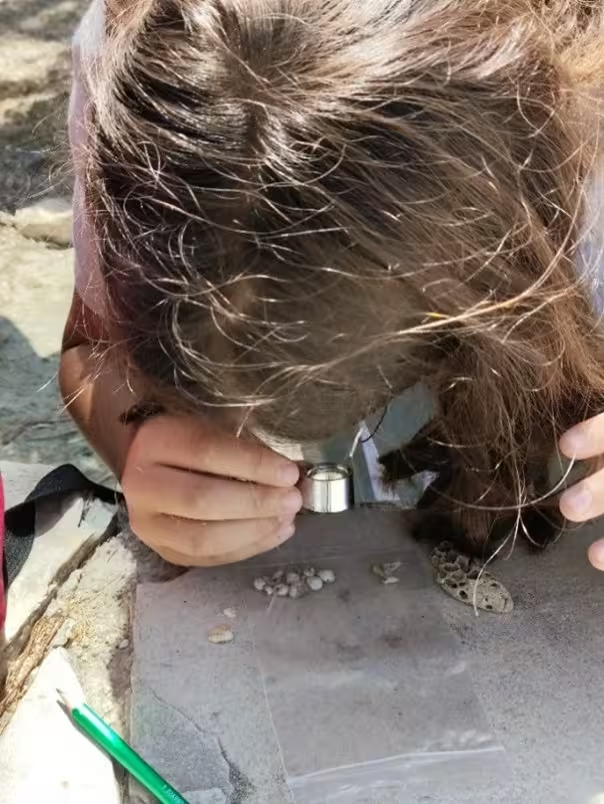
The Natural Sciences Living Lab, implemented in collaboration with the Department of Geology and Geoenvironment and under the scientific coordination of Professor Ariadni Argyriaki, Professor of Economic Geology and Geochemistry, is addressed to students aged 10 to 15 years.
Within the framework of the program, students participate in activities such as introduction to the methodology of field sampling, hands-on experience in the use of microscopes and sample preparation techniques, and samples’ observation using stereomicroscope and spectroscopic.
Food Detectives
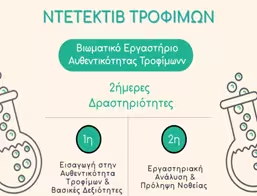
The Living Lab on Food Authenticity, implemented in collaboration with the Analytical Chemistry Laboratory and under the scientific coordination of Professor Nikolaos Thomaidis, Professor of Analytical Chemistry, is addressed to students aged 10 to 17 years.
The program is designed for students interested in discovering the level of authenticity of the food we consume and whether it has been adulterated. Through theoretical and interactive presentations, experimental activities, and laboratory analyses, participants are introduced to food analysis and food quality control techniques, while developing scientific skills to ensure food safety and quality.